
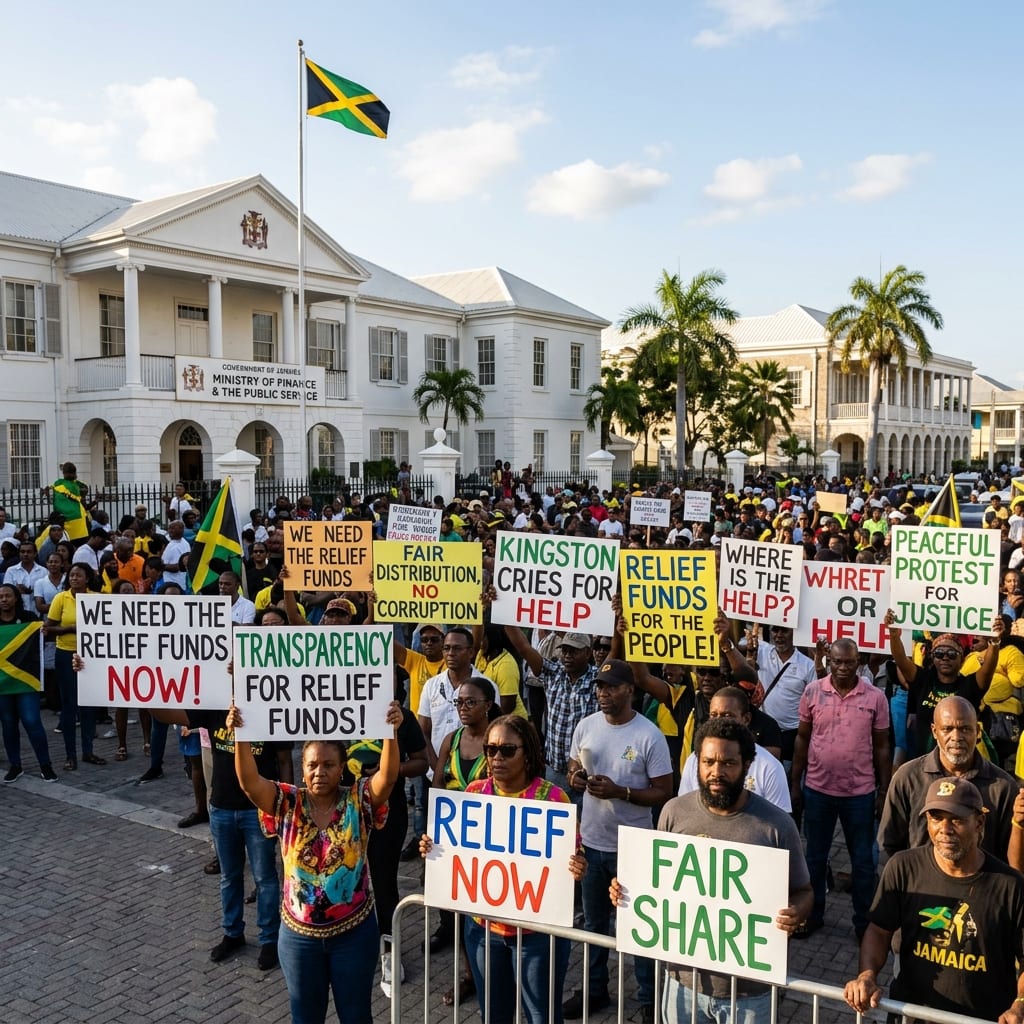
When Category 5 Hurricane Melissa tore through Jamaica in October 2025, it did more than destroy roofs and livelihoods. It placed the entire machinery of the state under pressure. Thousands of families across western and central parishes were left homeless. International donors and ordinary citizens responded with striking generosity — more than $1.44 billion Jamaican dollars flooded into government accounts. Nearly ten months later, a deeper question remains: What does a society discover about itself when the money meant to heal a wound is left largely untouched?
Natural disasters function as a kind of stress test. They strip away the comfortable narratives governments tell about readiness and competence, and force an unflattering examination of what the system can actually deliver when people are most vulnerable.
The Auditor General’s Findings
The Auditor General’s Special Audit Report, tabled in Parliament, made the results of that stress test difficult to ignore. As of late February 2026, of the $1.44 billion collected for Hurricane Melissa relief, only $26.2 million — a mere 1.8% — had been spent.
For the thousands still living under tarpaulins through the heat of mid-2026, the knowledge that 98.2% of the funds remained in bank accounts carried a particular weight. Bureaucracy, weak inter-agency coordination, and rigid procurement rules had slowed relief to a near standstill precisely when urgency was required. The numbers revealed not only delay, but a system that struggled to move under pressure.
Missing Records and the Problem of Accountability
The audit uncovered more than unspent money. It found gaps that raised harder questions about trust.
$34 million in roofing materials could not be properly verified because delivery logs and distribution records were incomplete or missing. Another $141.1 million in committed expenditure lacked full documentation or clear proof that the intended recipients ever received what was promised. These failures are not merely technical. They point to a deeper vulnerability: when systems designed to prevent abuse become so cumbersome that they prevent help from reaching those who need it, the original purpose begins to dissolve.
Public Outrage and the Limits of Patience
Once the findings became public, frustration moved into the streets. In June 2026, demonstrators filled Kingston, gathering at Cross Roads and outside the Ministry of Finance. Placards read “Spend Melissa Money Now!”, “Where Is the Relief?”, and “No Transparency, No Peace.”
People described months of waiting for building vouchers that never arrived. Community leaders from St. Elizabeth, Westmoreland, and Hanover spoke of the particular bitterness of watching international partners respond with speed while local processes remained tangled. There is something philosophically unsettling about a society that can raise money in crisis yet struggles to convert that money into care.
The Political Response
As expected, the issue became political. Opposition voices accused the government of incompetence and indifference, calling for an independent inquiry and a public dashboard that would show, in real time, how disaster funds are used.
Government officials, including Works and Information Minister Robert Morgan, rejected claims of corruption or total inaction. They argued that strict verification processes were necessary to prevent fraud. The National Roof Repair Programme was cited as evidence that materials had been distributed and that major contracts were now in place. Officials insisted that committing funds for large purchases naturally precedes the actual release of money, and that the pace would improve in the second half of 2026.
Both positions contain partial truths. The deeper issue is structural. A system built for ordinary times, with multiple layers of approval designed to prevent wrongdoing, can become dangerously slow when extraordinary need arrives. The stress test does not invent these weaknesses; it simply makes them impossible to ignore.
A Pattern, Not an Exception
This is not the first time unspent disaster funds have appeared. The Auditor General’s report noted similar balances left from earlier events, including Hurricane Beryl in 2024. The pattern suggests a chronic difficulty: Jamaica’s procurement and approval frameworks prioritise procedural caution in ways that can conflict with the speed required after catastrophe.
The tension is old and familiar. How does a society protect itself from abuse without becoming so careful that it fails the very people it claims to serve? Some argue that Jamaica needs a modern Emergency Procurement Framework — one that allows faster action while preserving transparency and independent oversight. Without such reform, every major storm will continue to reveal the same limitations.
The Erosion of Trust
Money is only part of what is at stake. Trust is harder to rebuild once it frays. When citizens and international partners give during a crisis, they do so under an unspoken agreement that the funds will ease suffering. When nearly 98% of that money remains unused for months, the social contract feels strained.
Civil society groups, rights organisations, and church leaders have called for clearer monthly reporting — by parish, community, and supplier. Transparency is not simply a technical improvement. It is a way of treating people as agents who deserve to know what happened to the help they offered and the help they needed.
What the Stress Test Demands
As another hurricane season approaches, the ‘Melissa money’ question remains unresolved. A few practical steps continue to be suggested:
- A live public portal: A clear digital platform showing real-time income, allocations, and spending by parish.
- Faster emergency vouchers: Moving away from slow physical supply chains toward audited digital cash or store vouchers for verified victims.
- Independent oversight: A non-partisan panel that includes civil society, private-sector voices, and the Auditor General’s office to help approve emergency disbursements.
Natural disasters do not create the character of a government; they reveal it. The story of the ‘Melissa money’ is a reminder that resilience is not measured only by how much aid a country can raise, but by whether its institutions can move with enough urgency, competence, and honesty to turn that aid into actual relief. When the next storm arrives — and it will — the same stress test will be applied again. The question is whether the system will have learned anything in the meantime.