
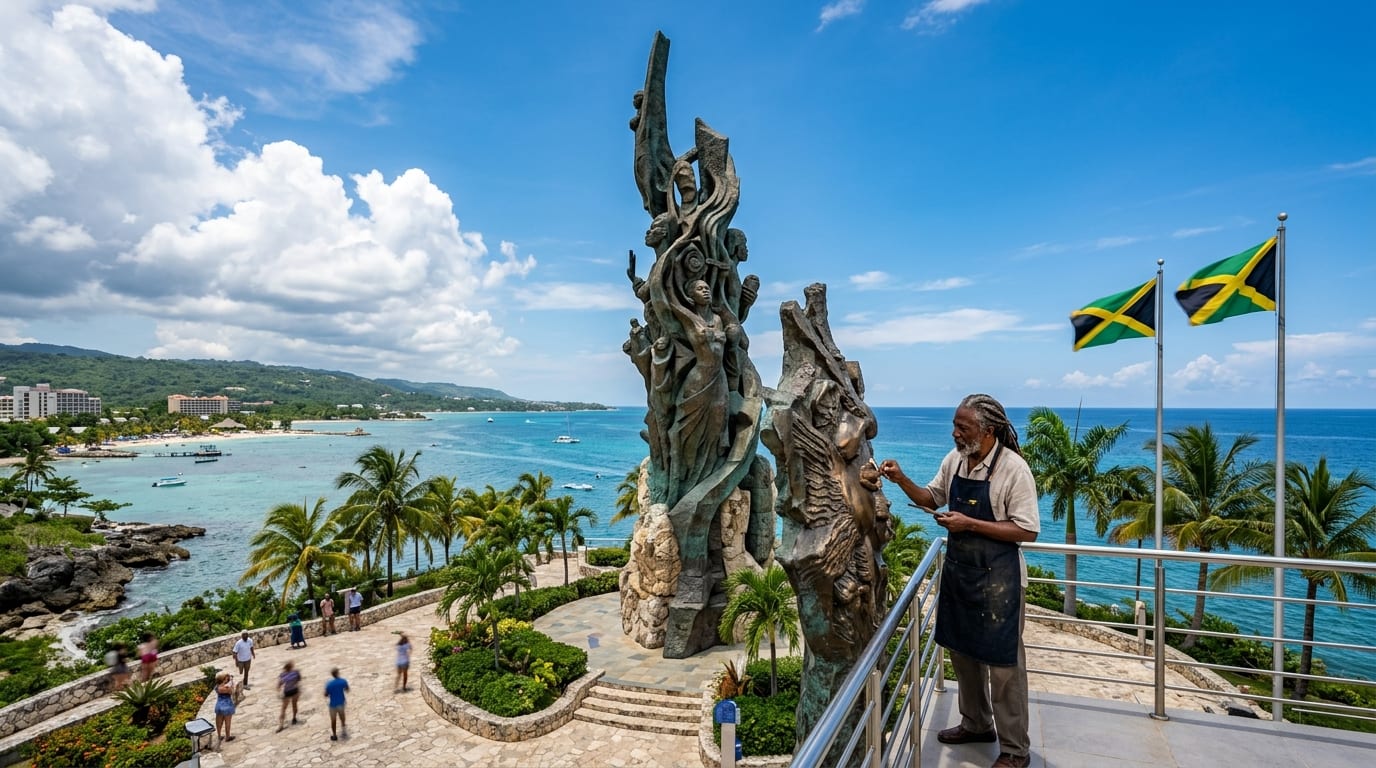
Against the azure backdrop of the Caribbean Sea in Montego Bay, St. James, a soaring new silhouette has risen above the coastline. Renowned Jamaican master sculptor Scheed Cole is applying the final protective patinas to a colossal 62-foot public art monument titled 'The Unbroken Spirit', erected to honor the heroic resilience and unity of Jamaican communities in the wake of Hurricane Melissa.
There is a particular silence that settles around a work of this scale just before it is finished. The sea continues its ancient conversation with the shore. The wind still moves through the palms. Yet something new now interrupts the horizon—a vertical insistence, a human answer to the horizontal violence of the storm. Cole’s hands, moving across bronze that will soon face salt and sun for generations, are completing more than a commission. They are closing a circle between catastrophe and creation, between the force that tried to unmake a people and the force that refuses to stay unmade.
The monumental installation, commissioned through a coalition of cultural heritage foundations, civic leaders, and diaspora arts patrons, stands as the largest contemporary bronze and natural limestone sculpture in the entire English-speaking Caribbean. Size, in this case, is not spectacle for its own sake. It is a philosophical claim. In a region long accustomed to the sudden erasure of houses, boats, and livelihoods, the decision to raise something this tall, this heavy, and this deliberately permanent is itself an act of defiance. The monument says, in the language of mass and height, that some things will not be allowed to disappear.
Art Born From Tragedy and Triumphant Solidarity
When Category 5 Hurricane Melissa struck western and central parishes, it tested the physical infrastructure and economic foundations of countless towns and fishing villages. Yet, amid the destruction, the true character of the Jamaican people emerged—neighbors clearing impassable roads with cutlasses, community kitchens feeding entire districts, and frontline workers restoring power lines through relentless torrential rains.
Scheed Cole's 62-foot masterpiece captures this visceral collective courage. Rising organically from a tiered base of native St. James limestone, the interlocking bronze figures represent the multifaceted pillars of Jamaican society: agricultural workers, mothers protecting their children, fishermen, builders, and emergency volunteers, all reaching upward toward a radiant communal flame.
There is an old insight, repeated across cultures that have known hardship, that true character is not revealed in comfort. It is revealed when the ordinary structures of daily life are stripped away and people must decide, in real time, whether they will turn inward or toward one another. Hurricane Melissa removed the illusion of isolation. In the days that followed, the island practiced a form of philosophy older than any written text: the understanding that survival is a collective verb. Cole has given that understanding a body. The figures do not stand alone. They interlock. Their upward reach is shared. The flame they hold is not the possession of any single person. It is the visible consequence of many hands refusing to let the light go out.
"This monument is not about grief; it is about triumph," explained Scheed Cole during an on-site studio briefing in Montego Bay. "It stands as an eternal physical declaration that no storm, no natural disaster, and no economic hardship can break the resolve of the Jamaican spirit. When we are knocked down, we rise higher, stronger, and together."
Cole’s distinction between grief and triumph is careful and necessary. Grief is real. Houses were lost. Livelihoods were interrupted. Lives were altered. Yet the monument declines to freeze the story at the moment of loss. It chooses instead the moment of rising. In doing so, it aligns itself with a long Caribbean tradition of art that refuses to let catastrophe have the final word. The bronze does not deny the storm. It answers it. The upward gesture of the figures is both physical and metaphysical: a refusal to remain defined by what tried to destroy them.
There is also a quieter philosophy at work in the choice of materials. The limestone base is local, drawn from the same earth the storm tried to scour. The bronze figures, though more permanent, will still weather. They will take on the salt, the sun, the slow chemistry of the marine air. In time the surface will change, as all living surfaces change. The monument is not designed to look forever new. It is designed to endure while remaining in conversation with the elements that once threatened everything around it. That, too, is a form of wisdom: the acceptance that resilience is not the absence of change, but the capacity to continue through change.
Architectural and Engineering Ingenuity
Constructing a 62-foot sculpture exposed to tropical marine environments required groundbreaking architectural and engineering innovation. Collaborating with structural engineers from the University of the West Indies (UWI), Cole incorporated an internal marine-grade stainless steel armature wrapped in hurricane-resistant architectural bronze casting.
The foundation is anchored 30 feet into bedrock to withstand Category 5 wind forces of up to 185 miles per hour, ensuring that the monument itself remains an indestructible beacon through any future meteorological challenges.
The surrounding plaza features landscaped gardens of indigenous flora, drought-resistant palms, solar-powered nighttime illumination, and educational bronze plaques chronicling the community heroes who saved lives during the storm’s aftermath.
There is something almost poetic in the engineering decisions. The same forces that once tore roofs from houses and boats from their moorings have been studied, calculated, and answered with depth and tensile strength. The monument is designed to remain standing in conditions that previously unmade entire communities. In this sense, the structure becomes a physical argument about knowledge itself. Human beings can learn from what tried to destroy them. They can turn the data of disaster into the design of endurance. The thirty feet of foundation driven into bedrock is not merely a technical specification. It is a statement of intent: we have looked carefully at the worst the climate can do, and we have chosen to build deeper than the storm can reach.
The plaza around the sculpture extends the philosophy outward. Indigenous plants, drought-resistant and local, root the site in the same ecological intelligence that the storm temporarily overwhelmed. Solar illumination means the monument does not depend on the fragile grids that failed during the hurricane. The educational plaques ensure that the names and actions of ordinary people are not absorbed into a vague national myth. Specific courage is remembered. Specific hands that cleared roads and fed neighbors are given permanent voice. In this way the site becomes both memorial and classroom, both aesthetic experience and moral instruction.
A New Cultural and Tourism Landmark for Western Jamaica
Civic and tourism leaders in Montego Bay anticipate that 'The Unbroken Spirit' will quickly become one of the most visited cultural landmarks on the island's north coast. Situated along a revitalized seaside promenade, the site will host civic gatherings, educational school tours, and cultural performances.
Local businesses and craft vendors in neighboring downtown Montego Bay have welcomed the development, noting that cultural heritage monuments enrich visitor experiences beyond traditional resort walls and direct economic benefits to local artisans and hospitality workers.
Tourism, when it is thoughtful, can become a form of cultural exchange rather than mere extraction. A monument of this kind invites visitors not only to look but to learn, not only to photograph but to pause. The economic benefits that may flow to nearby vendors and hotels are real and welcome. Yet the deeper value lies in the possibility that strangers will stand before the interlocking figures and recognize something of their own capacity for solidarity. Art that travels across differences of nationality and experience carries a quiet diplomatic power. It suggests that resilience is not a Jamaican monopoly. It is a human possibility that this particular people have demonstrated with uncommon clarity.
There is also a local dignity in the project’s insistence that cultural landmarks need not be confined to the capital or to the already-celebrated sites. Montego Bay, long known primarily for its beaches and hotels, now claims a major work of public art that speaks of its own recent history of trial and recovery. The monument roots high culture in the lived experience of the western parishes. It refuses the separation between the places where people suffer and the places where people are allowed to make meaning from that suffering.
Official Dedication Ceremony Scheduled
An official state unveiling and dedication ceremony is scheduled for late August 2026, featuring community leaders from hard-hit parishes, choral performances from the National Dance Theatre Company (NDTC), and poetry readings by celebrated Caribbean laureates.
As the sun sets over Montego Bay, casting warm golden hues across the 62-foot bronze silhouettes, the monument stands as a breathtaking testament: Jamaica's history is written in the unbreakable resilience of its people.
Dedication ceremonies are, at their best, acts of collective authorship. The people who lived through the storm will stand before the bronze that now represents them. The artists and engineers who gave the idea form will watch their work enter the public realm. Children who were too young to remember the hurricane will begin to learn its meaning through the sculpture that rose in its aftermath. In that gathering, the monument ceases to be the creation of a single sculptor and becomes the shared property of a community that has decided what it wants to remember about itself.
Philosophers have long debated the purpose of public monuments. Some argue they freeze history into simplified narratives. Others insist they can keep living questions alive. 'The Unbroken Spirit' leans toward the second possibility. It does not pretend that the storm never happened. It does not claim that suffering was noble in itself. It simply asserts, with the full weight of bronze and limestone and engineering calculation, that the response to the storm revealed something essential and durable about the people who endured it. The figures reach upward not because the danger has vanished, but because the capacity to rise has been proven.
In the years to come, salt air will continue its slow work on the surface. Tourists will take photographs. Schoolchildren will read the plaques. Community gatherings will assemble in the plaza. Through all of it, the sculpture will remain what it was designed to be: a vertical reminder that the most powerful forces in human life are not the ones that knock us down, but the ones that teach us how to stand again, together, and higher than before. Against the blue of the Caribbean Sea, under the same sky that once delivered the hurricane, 'The Unbroken Spirit' holds its ground. That, finally, is the quiet philosophy of the work: the decision to remain, and to remain in relation, no matter what the wind may bring.