
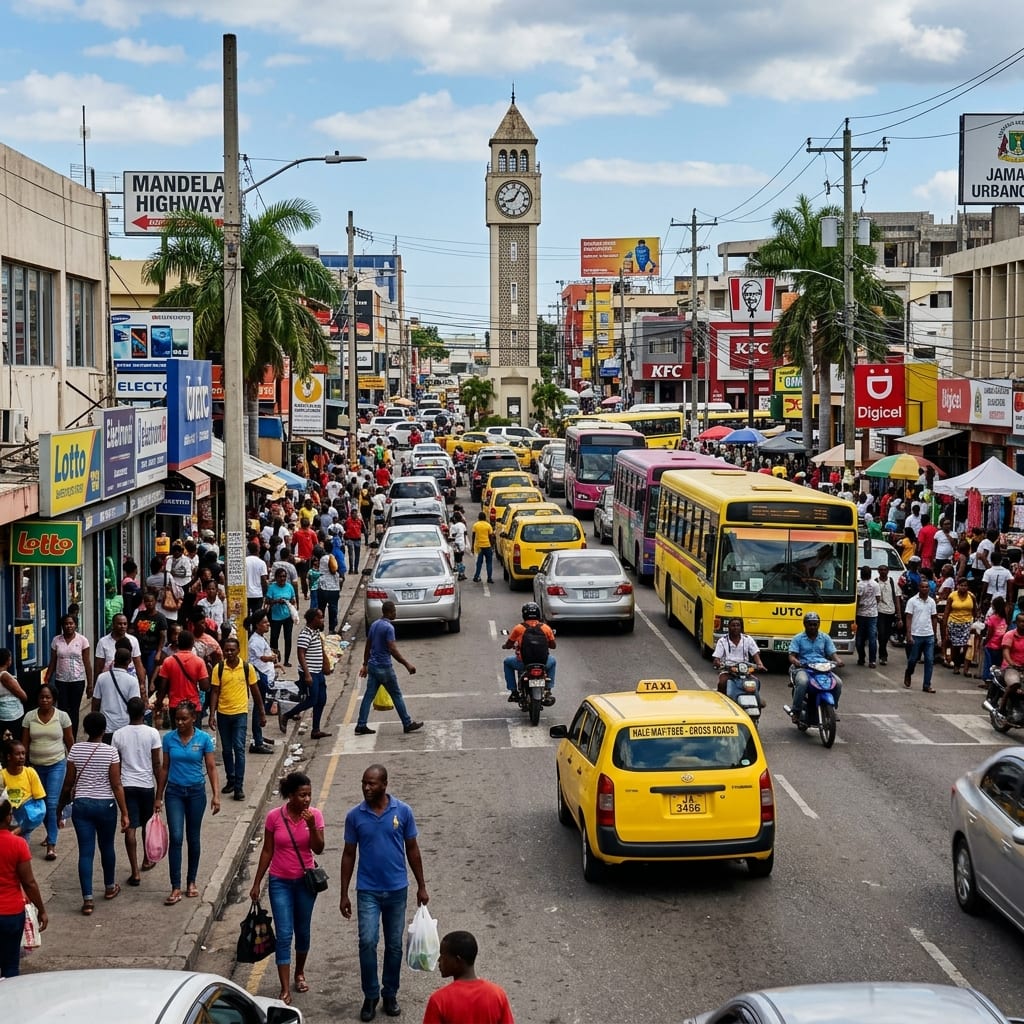
The Kingston and St. Andrew Municipal Corporation (KSAMC), in a joint operation with Tax Administration Jamaica, has officially launched a strict crackdown on delinquent property owners within the busy commercial hub of Half-Way-Tree.
There is a particular kind of quiet that settles over a city when the rules that hold it together begin to be enforced again. Half-Way-Tree, that dense and restless crossroads of commerce, traffic, and daily survival, has long been a place where the formal and the informal meet in uneasy partnership. Now the partnership is being recalibrated. The announcement of a targeted operation against delinquent property owners is not merely an administrative notice. It is a public statement about the obligations that bind private ownership to the shared life of the city.
Property, in any society, is never only a private possession. It is also a claim on the collective resources that make ownership meaningful: the roads that bring customers, the drainage that prevents flooding, the streetlights that allow evening trade, the security that keeps the commercial pulse beating. When those shared supports are funded unevenly, the entire arrangement begins to fray. The current crackdown is an attempt to restore the balance before the fraying becomes permanent.
Targeting Arrears
According to recent reports, the operation is specifically targeting 432 properties that have accumulated significant arrears in property taxes. The initiative is part of a broader effort by the KSAMC to ensure compliance and recover much-needed municipal revenue.
Four hundred and thirty-two properties is not an abstract figure. Each one represents a decision, repeated over time, to withhold a contribution that others have continued to make. In a commercial district as vital as Half-Way-Tree, those decisions accumulate into something larger than individual shortfalls. They become a quiet redistribution of burden. The compliant owner subsidizes the non-compliant one. The small trader who pays on time helps fund the infrastructure that the delinquent owner continues to enjoy. Over seasons and years, the pattern breeds a sense of unfairness that no city can afford indefinitely.
There is an old philosophical insight that the health of a commonwealth depends less on the brilliance of its laws than on the willingness of its members to treat those laws as binding even when enforcement is imperfect. Property tax is one of the clearest expressions of that insight. It converts the private benefit of land and buildings into a public contribution. When the conversion fails for hundreds of properties in a single commercial hub, the failure is not only fiscal. It is civic. It signals that the mutual obligations of urban life have weakened.
"We are urging all property owners to regularize their status immediately. The funds collected are crucial for maintaining the city’s infrastructure and services," a representative stated.
The representative’s language is practical, yet it points toward a deeper truth. Infrastructure is the physical form of the social contract. Roads, drains, lighting, waste collection, and the administrative systems that keep them functioning are the visible evidence that the city still regards itself as a shared project. When revenue falters, that evidence begins to decay. Potholes widen. Flooding becomes more frequent. Services grow uneven. The decay is never evenly distributed. It falls hardest on those least able to insulate themselves from it. In this sense, chronic non-payment is not a victimless act. It is a gradual transfer of cost onto the most vulnerable users of the public realm.
The authorities have indicated that they will utilize all legal avenues to recover the outstanding sums, a move that is expected to send a strong message to non-compliant property owners across the corporate area. Legal avenues, when used consistently, perform a moral function as well as a practical one. They reassert that the rules are not optional suggestions. They remind owners that the privileges of property are tethered to corresponding duties. In a city where informal arrangements sometimes blur the edges of obligation, a clear and public enforcement action restores the distinction between what is permitted and what is required.
There is a philosophical tension that every municipal authority must navigate. On one side stands the principle of individual economic freedom: the right of an owner to manage property and cash flow according to private calculation. On the other stands the principle of collective responsibility: the recognition that private calculation, left entirely unconstrained, can undermine the very conditions that make private calculation possible. Half-Way-Tree’s commercial vitality depends on a functioning public environment. That environment does not maintain itself. It is paid for, in part, by the taxes now being pursued. The crackdown is therefore not an attack on ownership. It is an attempt to preserve the conditions under which ownership remains valuable.
Cities are among the most complex moral experiments human beings have devised. They ask strangers to share space, resources, and risk in the service of mutual advantage. Property tax is one of the mechanisms that makes the experiment workable. When large numbers of owners withdraw from that mechanism while continuing to benefit from its results, the experiment begins to lose legitimacy. The compliant majority starts to wonder why they should continue carrying a burden others have set down. Over time, voluntary compliance erodes. The present operation is an effort to interrupt that erosion before it becomes irreversible.
Half-Way-Tree itself is a fitting stage for this particular drama. It is a place of constant motion, of layered histories, of formal businesses and informal livelihoods occupying the same crowded geography. The 432 properties under scrutiny sit inside a district that has long absorbed the pressures of rapid urbanization, inadequate planning, and competing claims on limited space. To demand that those properties meet their fiscal obligations is also to demand that the district’s future be treated as a shared responsibility rather than a collection of private strategies.
There is, of course, room for nuance. Not every instance of arrears arises from willful disregard. Economic hardship, administrative confusion, disputed valuations, and the lingering effects of wider shocks can all play a part. A just enforcement regime must leave space for legitimate hardship to be heard and addressed. Yet the existence of hardship does not erase the broader pattern. When hundreds of commercial properties fall into significant arrears, the pattern itself becomes the issue. Selective non-compliance, if left unanswered, teaches others that the system can be gamed. The only durable answer is consistent, transparent, and fair application of the rules.
The funds recovered will, if the representative’s statement is accurate, return to the maintenance of infrastructure and services. That return is the closing of a moral circle. Money extracted from private holdings is converted into public goods that protect and enhance those same holdings. Street repairs reduce the cost of doing business. Functioning drains protect inventory and foot traffic. Reliable lighting improves security for workers and customers alike. In this conversion, the private and the public are revealed as interdependent rather than opposed.
Philosophers of the city have often noted that urban life requires a continuous act of translation: the translation of individual interest into collective capacity. Property tax is one of the most ordinary and most essential instruments of that translation. When it functions, the city remains capable of renewing itself. When it fails, the city begins to live on borrowed time, consuming the infrastructure of previous generations without replacing it. The current crackdown is an attempt to stop the borrowing and restore the cycle of contribution and renewal.
As the operation unfolds, its success will be measured not only in dollars recovered but in the signal it sends. A city that enforces its own rules declares that it still believes in the possibility of fairness. It declares that the commercial advantages of a location like Half-Way-Tree come with corresponding duties. It declares that the shared environment is not a free resource to be endlessly extracted. In a time when many public institutions struggle to demonstrate effectiveness, a focused and visible effort to collect what is owed can restore a measure of civic confidence.
The deeper question the operation raises is older than any municipal corporation. What does a community owe itself? What obligations attach to the privilege of owning a stake in a shared urban space? How does a society prevent the slow drift from mutual responsibility toward private exception? Half-Way-Tree, with its 432 delinquent properties now under formal scrutiny, has become a temporary laboratory for these questions. The answers will be written not only in court filings and payment plans, but in the condition of the streets, the reliability of the drains, and the quiet knowledge among owners that the rules, once again, apply.
In the end, the crackdown is less a story about punishment than a story about maintenance—maintenance of infrastructure, yes, but also maintenance of the civic understanding that makes a city more than a collection of private plots. The azure sky above Kingston does not distinguish between the compliant and the delinquent. The rain falls on both. The traffic moves past both. The only distinction that matters is the one the community itself chooses to enforce. By choosing enforcement in Half-Way-Tree, the KSAMC and Tax Administration Jamaica have chosen to insist that the shared life of the city still has a claim on those who profit from it. That insistence, if sustained with fairness and consistency, may prove as important as the revenue it recovers.