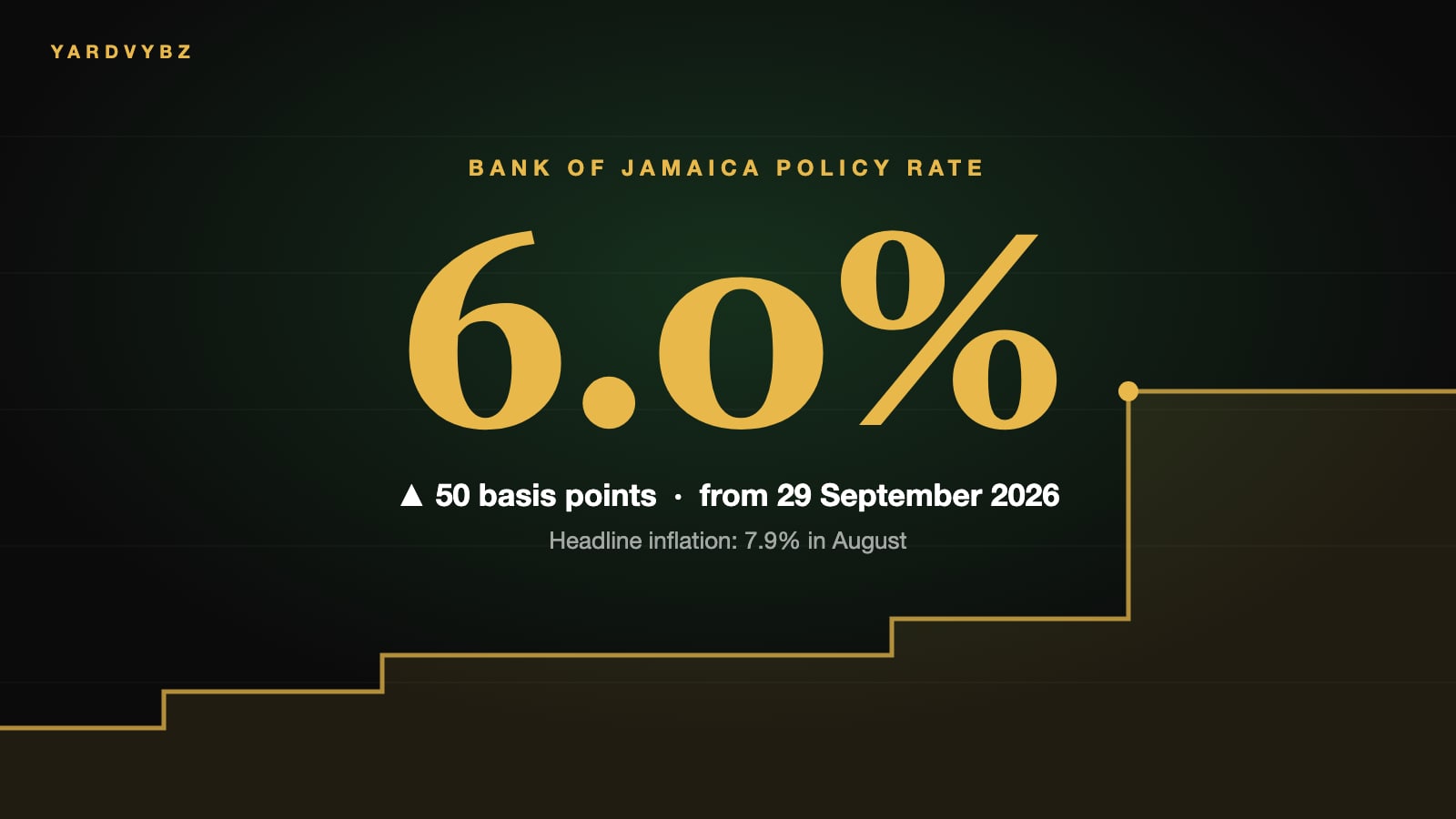
The Bank of Jamaica (BOJ) has raised its policy interest rate by 50 basis points to 6.0 per cent, the central bank's clearest signal yet that it is worried about how quickly prices are rising. The increase took effect on Tuesday, 29 September 2026, after the Monetary Policy Committee (MPC) met on 24 and 25 September and voted unanimously for the move.
For most Jamaicans the policy rate is an abstract number. Its effects are not. It is the rate the BOJ pays commercial banks on overnight deposits, and it sets the floor for what banks charge on loans and pay on savings. When it rises, borrowing gradually becomes more expensive across the economy.
Why the BOJ moved now
The trigger is inflation. Data from the Statistical Institute of Jamaica show headline inflation reached 7.9 per cent in August 2026, up from 7.5 per cent in July. That is well outside the BOJ's 4 to 6 per cent target range. Core inflation, which strips out the most volatile food and fuel prices, held at 5.2 per cent.
In its summary of the decision, the MPC pointed to pressures at home and abroad:
- Global tensions. Escalating conflict in the Middle East and the continuing Russia-Ukraine war have kept commodity prices elevated.
- El Niño. Intensified dry conditions have cut crop yields and are expected to keep agricultural prices high for longer than first projected.
- Tighter global financial conditions, arriving faster than the bank had forecast.
- Second-round effects. Higher farm-gate and import costs are now showing up in processed food and services.
- Expectations. Businesses surveyed in July expected inflation of 7.3 per cent, up from 6.7 per cent in June.
That last point matters most to a central bank. Once firms and workers assume prices will keep rising, they set prices and wage demands accordingly, and a temporary shock becomes a lasting one. The BOJ said the increase is meant to stop that from happening.
The committee had held the rate steady in August. The bank has defended that call, saying it was appropriate given the conditions and risks assessed at the time, which have since worsened.
What it means for borrowers
The policy rate does not change your loan overnight, but it does change the direction of travel.
- Variable-rate loans are the most exposed. If your mortgage, car loan or business line of credit carries a floating rate, check the terms and ask your lender whether an adjustment is planned.
- New loans are likely to be priced higher in the coming months. If you are about to borrow, compare offers and ask how long a quoted rate is locked in.
- Fixed-rate loans are unaffected until the fixed period ends.
- Credit cards and micro-loans already carry rates far above the policy rate. Paying down this debt first remains the best return available to most households.
Private-sector credit was still growing at 7.9 per cent in July, according to the BOJ. Slowing that growth is part of how a rate increase cools demand.
What it means for savers
Savers stand to gain slowly. Deposit rates tend to follow the policy rate with a lag, and banks typically pass on increases to borrowers faster than to depositors. With inflation at 7.9 per cent, money in an ordinary savings account is still losing purchasing power. It is worth comparing fixed deposits and other instruments rather than waiting for your current account rate to move.
The dollar and the wider economy
The BOJ described Jamaica's international reserves as healthy and a strong buffer, and said it expects the exchange rate to remain relatively stable. The US dollar closed at J$159.87 on Wednesday, 30 September, up seven cents on the day, according to the bank's published rates.
The harder question is growth. The increase comes while the economy is already weak. Preliminary estimates from the Planning Institute of Jamaica show output shrank 2.9 per cent in the April to June quarter, with agriculture, forestry and fishing down 15.3 per cent as the island continues to absorb the effects of Hurricane Melissa and the drought. Raising rates in a contracting economy is uncomfortable, and the BOJ acknowledged that growth remains vulnerable in the 2026/27 fiscal year because of agricultural shocks and limits on tourism capacity. It expects activity to strengthen in 2027/28.
What to watch next
The bank's own forecast is that inflation will rise further before returning to the target range by mid-2027. That means this may not be the last increase. Three things will shape the next decision: the monthly inflation figures, whether rain eases the pressure on food prices, and what happens to oil and shipping costs abroad.
For households, the practical message is to plan for higher borrowing costs to last into next year, and to treat any variable-rate debt as the first thing to review.